How to Convert a PDF to Excel Online
Quick answer
Upload your file to PDF to Excel and download an XLSX — there is nothing to configure, because table boundaries are detected automatically. Only tabular content comes across; paragraph text outside a table is skipped, since there is nothing in it to rebuild as cells. Check column alignment on the first few rows afterwards, and run a scanned table through OCR first or it will not extract at all.
What PDF to Excel actually extracts
PDF to Excel looks for table-like structures in the document — rows and columns of numbers, invoices, financial statements — and rebuilds them as real spreadsheet cells instead of a flat image or unstructured text block. Regular paragraph text outside a table is skipped, since there's nothing tabular to extract.
Converting a PDF with tables
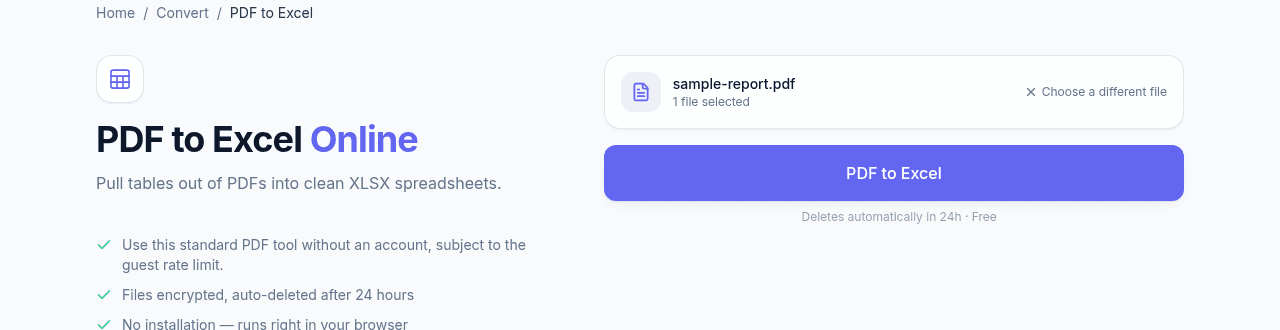
Upload the PDF and click PDF to Excel — there are no extra settings to configure, since the tool detects table boundaries automatically. Processing happens in the cloud, the same as every other converter here.
What to check after downloading
Open the XLSX and verify column alignment on the first few rows — tables with merged cells, nested headers, or inconsistent spacing in the source PDF are the most common cause of a column landing one cell off. A scanned PDF (an image of a table, not real text) won't extract at all; run it through OCR PDF first so there's actual text for the extractor to find.
Frequently asked questions
Why is only part of my PDF in the spreadsheet?
Because only tabular content is extracted. Paragraph text, headers and footnotes sitting outside a table have no rows and columns to rebuild as cells, so they are skipped. If you need the prose as well, convert the same file to Word instead.
Why did one column land a cell off?
Merged cells, nested headers and inconsistent spacing in the source are the usual causes. Check alignment on the first few rows every time — a shifted column is the failure that is easiest to miss and the most damaging to anything you calculate from it afterwards.
Can I convert a scanned table?
Not directly. A scan is a picture of a table with no characters in it, so there is nothing for the extractor to find. Run OCR first to add a text layer, then convert that result — and check the recognized figures, because OCR errors in numbers are easy to read straight past.
Are formulas preserved?
No, and they were never in the PDF to begin with. A PDF stores the printed result of a calculation rather than the calculation itself, so what comes back are values. Any formulas you need have to be rebuilt in the spreadsheet.